If you have recently stumbled upon VisiFlora while searching for an eye-health supplement, you may be asking yourself, what is VisiFlora, what is it made of, what claims does it make, and is it something that you would want to try?
What Is VisiFlora? In short, VisiFlora is a daily dietary supplement that makes nutritional health claims for your eyes. In marketing copy, the company uses language that describes a multi-ingredient formula consisting of vitamins, antioxidants, carotenoids, minerals, and botanical extracts that are said to support overall eye health and wellness.
The formula is also marketed around the idea of the gut-eye connection, combining traditional eye-health nutrients with ingredients positioned as supporting digestive or internal balance.
It is important to note that in order to understand what exactly a certain ingredient can do for the body, it is not enough to simply rely on the manufacturers’ marketing. Even if a substance has a decent level of research to back its potential benefits, this does not necessarily mean that the specific product in question will have the same effect in every individual case.
This guide aims to provide you with information regarding the VisiFlora dietary supplement, including its ingredients, the rationale behind them, as well as an assessment of possible effects it may or may not have. We will also try to give you some pointers on what to look out for when considering this particular product.
Learn More About VISIFLORA
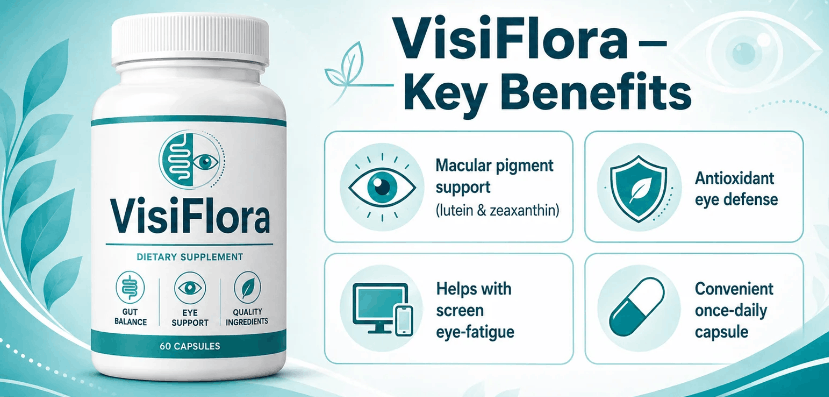
What Is VisiFlora?
What Is VisiFlora? According to the information provided on the website, VisiFlora is a daily vision supplement that contains a combination of nutrients and botanical ingredients.
The product is a 22-ingredient formula made up of carotenoids, vitamins, minerals, antioxidants, and various botanical extracts. The ingredients most commonly found in the product’s descriptions are lutein, zeaxanthin, bilberry extract, vitamin A, vitamins C and E, zinc, selenium, taurine, grape seed extract, quercetin, and others.
Rather than being presented as a prescription medicine, VisiFlora is positioned as a nutritional supplement that people can add to their daily wellness routine.
That distinction is important.
A dietary supplement may provide nutrients associated with normal physiological functions, but it should not automatically be considered a treatment for an eye disease.
What Is the VisiFlora Eye Health Supplement Designed For?
The VisiFlora eye health supplement is marketed primarily around general eye and vision support.
According to current product descriptions, the formula is intended to support areas such as:
- General eye wellness
- Nutritional support for the retina and macula
- Visual comfort
- Antioxidant support
- Eye nutrition
- Support for people concerned about screen exposure
- Overall long-term eye-health habits
Some product pages also promote the formula for visual clarity, night-vision support, and digital eye comfort. These are marketing claims about the intended role of the product, not guarantees that every user will experience those results.
For that reason, consumers should look at the ingredients and evidence rather than assuming that every advertised benefit will apply to them.
What Is the VisiFlora Formula?
One of the main features that makes the product interesting to consumers is the broad VisiFlora formula.
Instead of using a product with one active ingredient, the company offers a more comprehensive solution that consists of several components with pronounced effects.
The most famous and proven components that can be found in the composition of the formula are:
Lutein
Lutein is a carotenoid pigment present in foods and in the body. It is found mainly in the macula of the eye.
According to the National Eye Institute, lutein and zeaxanthin are found in the retina and also in the lens, where they may function as antioxidants and help to filter blue light from entering the eye.
Zeaxanthin
Zeaxanthin is another carotenoid closely associated with macular health.
Lutein and zeaxanthin are also components of the AREDS2 nutritional formulation studied by the National Eye Institute, although it is important to understand that AREDS2 is a specific clinically studied formulation and is not the same thing as VisiFlora.
Bilberry Extract
Bilberry is a botanical ingredient frequently included in products marketed for eye and antioxidant support.
VisiFlora product information lists bilberry among the plant-based components of its formula.
Vitamin A
Vitamin A has an established nutritional role in normal vision.
The National Eye Institute explains that vitamin A is required by the retina to detect light and convert it into electrical signals.
Vitamin C and Vitamin E
These vitamins are commonly used in nutritional formulas because of their antioxidant functions.
VisiFlora product descriptions list both vitamin C and vitamin E among the formula’s ingredients.
Zinc
Zinc, meanwhile, is another mineral that has been included in many eye-health nutritional formulations.
It is also a component of the AREDS2 formulation investigated by the National Eye Institute. However, the amount and combinations used in AREDS2 are not necessarily reflective of what is contained in VisiFlora.
Other Botanical and Antioxidant Ingredients
Current VisiFlora product pages also mention ingredients such as grape seed extract, quercetin, taurine, alpha-lipoic acid, selenium, rutin, and other botanical compounds.
The presence of these ingredients explains why the product is marketed as a multi-ingredient vision-support formula rather than a basic single-vitamin supplement.
VisiFlora and the Gut-Eye Connection
One feature that differentiates the product’s marketing from many traditional eye supplements is its emphasis on the gut-eye connection.
What Is VisiFlora? According to the company’s motto, it is not just an eye-vitamin formulation. It is supposed to be an “inside-out” formula that combines eye-caring nutrients with detoxifying ingredients that will improve the condition of the whole body.
The connection between the work of the intestine and eyesight is an actively developing direction of science; however, customers should be careful about such theories and not fall for a marketing ploy.
In other words:
Scientific interest in the gut-eye connection ≠ proof that VisiFlora will improve your vision.
The concept may help explain why the manufacturer chose to include certain ingredients, but more research would be needed to establish specific outcomes for the complete branded formula.
Why Are Lutein and Zeaxanthin Important?
Lutein and zeaxanthin are two nutrients that stand out in the ingredients list of VisiFlora.
They are types of carotenoids, which are pigments found naturally in plants. Leafy green vegetables are especially rich in them.
According to the National Eye Institute, lutein and zeaxanthin are found in the retina and were studied as part of AREDS2. Taking the AREDS2 formulation as a whole can reduce the risk of intermediate age-related macular degeneration progressing to advanced AMD.
But there is an important distinction:
AREDS2 is not VisiFlora.
AREDS2 was a clinical-trial formulation with specific amounts of nutrients. The National Eye Institute advises talking to your eye care practitioner about this study.
Therefore, you can’t take a supplement that includes lutein and zeaxanthin and say that it has been clinically proven to prevent or slow Age-related Macular Degeneration.
That is an important point for anyone researching the VisiFlora formula.
What Are the Potential Benefits of VisiFlora?
The potential appeal of VisiFlora for eye health comes largely from the combination of ingredients included in the formula.
Depending on the individual’s nutritional needs and expectations, people may be interested in the product because it provides:
1. Nutritional Eye Support
The formula contains several nutrients and plant compounds associated with eye-health nutrition.
2. Antioxidant Support
Several ingredients in the formula are marketed for antioxidant support.
3. Carotenoid Support
Lutein and zeaxanthin are included as key carotenoids associated with the retina and macula.
4. Convenient Daily Formula
Instead of buying multiple individual nutrients, the product combines multiple ingredients into one supplement.
5. Interest in Gut-Eye Nutrition
The formula is marketed around the idea that internal balance and eye wellness may be connected.
These points explain why consumers may find the VisiFlora vision support concept interesting.
However, potential nutritional support should not be confused with a guaranteed improvement in eyesight.
Does VisiFlora Improve Vision?
This is one of the most important questions to answer honestly.
There is a difference between:
supporting normal eye health
and
improving or restoring vision.
The product ViFlora is advertised as a nutritional supplement for the eye health, but this does not mean it can be claimed to cure loss of vision, cataracts, glaucoma, macular degeneration, or other eye disease
Based on National Eye Institute’s AREDS study, it is proved that certain types of nutritional supplements may reduce the progression of intermediate or advanced age-related macular degeneration in some people, but these results are related only to the specific AREDS/AREDS2 formulation and patient’s category.
They should not automatically be transferred to another supplement.
Therefore, anyone considering VisiFlora should keep expectations realistic.
Who Might Be Interested in VisiFlora?
The product may attract adults who are looking for a convenient nutritional approach to eye wellness.
For example, someone might research VisiFlora because they:
- Spend many hours looking at screens
- Want to increase their intake of certain eye-health nutrients
- Are interested in lutein and zeaxanthin
- Want a combination formula rather than individual supplements
- Are interested in general nutritional eye support
- Want to learn more about ingredients associated with eye health
That does not mean everyone in these categories needs VisiFlora.
A person’s nutritional needs depend on their diet, health history, medications, age, and other factors.
VisiFlora for Eye Health: What Should You Expect?
If you are considering VisiFlora for eye health, it is useful to approach the product as a nutritional supplement rather than an instant solution.
A reasonable approach is to:
- Read the complete ingredient information
- Understand what the product is designed to support
- Avoid expecting guaranteed results
- Consider your existing diet and supplements
- Speak with an eye-care professional if you have an eye condition
- Follow the product’s recommended directions
This approach makes it easier to evaluate the product without unrealistic expectations.
What VisiFlora Cannot Replace
Even if someone chooses to use a nutritional supplement, it should not replace regular eye care.
VisiFlora should not be considered a substitute for:
- Comprehensive eye examinations
- Prescription glasses or contact lenses
- Treatment for diagnosed eye disease
- Medical evaluation of sudden vision changes
- Treatment for eye injuries
- Professional management of glaucoma, cataracts, AMD, or other conditions
If you experience sudden vision loss, significant eye pain, flashes of light, a sudden increase in floaters, or other concerning changes, seek professional medical care rather than relying on a supplement.
Check Current VISIFLORA Information

VisiFlora vs. Regular Eye Vitamins
Another reason consumers search for What Is VisiFlora? is to understand how it differs from a basic eye vitamin.
A basic eye supplement may contain only a few nutrients, such as vitamin A, zinc, lutein, or zeaxanthin.
VisiFlora is marketed as a broader formula containing multiple vitamins, carotenoids, antioxidants, and botanical extracts. Current product pages describe it as a 22-ingredient formula.
That broader formula may appeal to someone who prefers an all-in-one supplement.
On the other hand, more ingredients do not automatically mean better results.
The important questions are:
- Are the ingredients appropriate for you?
- Are the amounts clearly disclosed?
- Do you actually need additional supplementation?
- Are you taking other supplements with overlapping ingredients?
- Does the product fit your personal health situation?
These questions are more useful than simply counting the number of ingredients.
Is VisiFlora Scientifically Proven?
This is another area where careful wording matters.
Some individual ingredients used in eye-health supplements have scientific research behind them.
For example, the National Eye Institute conducted clinical research on particular formulations of nutrients and antioxidants like zinc, lutein, and zeaxanthin.
However, this does not necessarily mean that individual ingredients have been scientifically proven to be effective.
So, what is VisiFlora? A commercial product, which may be considered as a dietary supplement for eye care, not a medication proven to treat eye disease.
This distinction allows consumers to understand both the potential nutritional rationale and the limits of the evidence.
Things to Consider Before Buying VisiFlora
Before purchasing any dietary supplement, it is worth checking several things.
Ingredient transparency
Look at the complete Supplement Facts information and understand what you are taking.
Existing medications
Some supplements may interact with medications or may not be appropriate for certain medical conditions.
Existing eye conditions
If you already have an eye diagnosis, ask your eye-care professional whether a supplement is appropriate.
Overlapping supplements
If you already take a multivitamin or another eye supplement, check whether ingredients overlap.
Realistic expectations
Avoid products or testimonials that make unrealistic promises about restoring eyesight or curing disease.
Why Some People May Choose VisiFlora
The appeal of VisiFlora is relatively straightforward.
It combines multiple nutrients and botanical ingredients into a single daily formula, with particular attention to ingredients commonly associated with eye-health nutrition.
For people researching a VisiFlora eye health supplement, the combination of lutein, zeaxanthin, vitamins, minerals, and botanical compounds may be one reason the product attracts attention.
The product’s extra emphasis on the gut-eye connection also provides it with a different marketing angle than traditional eye vitamin products.
However, in the end, it is up to the consumers to decide, based on the ingredients, evidence, circumstances, and professional help if needed.
How to Learn More About VisiFlora
If you want to research the product closer, the next step is to learn more about products’ full list of ingredients, current product details, and purchasing option.
While reviewing the product page, make sure to focus on ingredient list and serving information instead of the fluff that companies tend to write on the web pages.
Related Guide: Does VisiFlora Actually Work?
If you are mainly interested in customer experiences and whether the product’s claims should be viewed realistically, our related article covers that topic in more detail:
Does VisiFlora Actually Work? Real Customer Results Explained
That article looks at customer-reported experiences, potential benefits, concerns, and the difference between testimonials and evidence.
This internal link is especially useful because readers who first want to understand what VisiFlora is can then move to the separate article about reported results.
Final Thoughts: What Is VisiFlora?
So, What Is VisiFlora?
The manufacturer is proposing a daily eye and vision supplement, which contains a comprehensive range of vitamins, carotenoids, antioxidants, minerals, and botanical ingredients.
The supplement provides eye health formulas that include nutrients such as lutein and zeaxanthin, which are familiar to most people as important components in eye health.
The manufacturers claim that they have blended the ingredients based on the antioxidants and digestive-tract health benefits they provide for the eyes.
The National Eye Institute has conducted studies involving combinations of the mentioned nutrients in patients with different forms of age-related macular degeneration, such as lutein, zeaxanthin, vitamins, and minerals.
It bears noting that these results do not prove VisiFlora as a cure, preventative, or treatment for vision problems.
The most balanced way to look at VisiFlora is as a nutritional eye-support product that may appeal to people interested in adding a combination of eye-health nutrients to their routine.
If you are considering it, review the formula carefully, maintain realistic expectations, and consult an appropriate healthcare professional if you have an existing eye condition or take medications.
Visit the Official VISIFLORA Website
Disclaimer
This article is for general informational and educational purposes only. It is not medical advice and does not diagnose, treat, cure, or prevent any disease or medical condition. Individual responses to dietary supplements vary. Always consult a qualified healthcare professional before starting a new supplement, particularly if you have an existing medical condition, take medication, are pregnant, or are nursing.
Pingback: Does VisiFlora Actually Work? Real Customer Results Explained